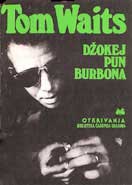
After seven years of gathering
material and doing research, this book was finally done in
1991, when the war in Yugoslavia already started.
“When I
first stumbled upon a Tom Waits record—in Amsterdam,
thirteen years before—I discovered a very masochistic
side of me: every time I played his songs they would hit
a painful spot, yet I had to repeat the experience. Very
soon I knew I had to do a book about him, but there was always
another, more urgent project,” says Dragan.
The American media largely ignored Waits’ early
years, and it was difficult finding even basic details
about his life. Letters to his publishers
were never answered, and even his agents played deaf. So
Dragan informed practically everyone he knew that he was
collecting everything related to Waits, and they started
sending articles, interviews, reviews, news, and records.
“On two occasions I tried to send a copy of the
book to Tom Waits,” says Todorovic. “Once, Jim Jarmusch was
in Belgrade for the Film Festival. His host was Emir Kusturica,
and through him I arranged a short meeting. I gave him
two copies of the book and a short letter for Waits, but
I doubt it ever got to him – Jarmusch had a glass
full of vodka in his hand at all times. Second time it
was after Waits’
concert in Toronto, and I prepared a neat little package,
but they thought I was a groupie, and the furthest I
got was the third assistant of the second stage manager
in the night shift.”
Excerpt from the introduction to “...Subway”:
[...]
The dome on the Temple of Holy Rock for almost twenty
five years rested on four supporting pillars: Youth,
Mutiny, Communication and Fun. Since the beginning
it was “understood” that rock emerged as fun different
from parents’ fun.
In the living room, parents played the games that took
two to play; behind the doors, their children danced
in circle a ritual dance that demanded generational belonging.
Using language that consisted
of less than 2,000 words, within the boundaries of associative
mechanism adjusted to the teen age, early rock and roll
was highly specialized product and aimed mainly at announcing,
celebrating and commenting the first loves in the age
when brain and body do not have perfect communication.
More than music, less than art, rock of that period avoided
the vertical penetrating power and spilled into the horizontal
level of generational code. For understanding and enjoying
of a classical rock song of the early period, sung in
English, one needed not to live in a country where English
was spoken, but to be young. There are social spaces
where tie is required at the entrance. At the entrance
of rock and roll tie is forbidden.
[...]
In November 1965 The Who made My
Generation. Pete Townshend
wrote a verse covered by much ink
of the scholars since then: “I
hope I’ll die before I grow old”. Townshend is 51 today and still
is active.
Ian Anderson of Jethro Tull wrote in 1976 another indicative verse: “Too
old to rock and roll, too young to die”. Anderson is 49 and still writes
good music.
Robert Plant is 48. Mick Jagger 53.
After the faceless period of 1980s the audience started
searching for personalities, for the individuals with clear and emphasized
message and attitude.
Rock establishment gladly supported this trend. Why, when one pillar of the
Temple was ruined, namely Youth, and the other one—Communication—was
attacked by this? For many reasons, but the basic ones were:
“Old Men” were good for business: It was much easier to further push
an already established career of a star such as David Bowie, then to fabricate
a new star.
“Old Men” socially mirrored the Eighties, a decade in which new terms—such as
Yuppies and DINK—were born.
“Old Men” did not talk about gap
among generations anymore. Their targets were fascism,
autocracy, human rights. Their songs did not consist
of the street-fighting
paroles; they were more like poetic commentaries.
“Old Men” were not an instant product but a result of a process similar
to the one found in the Oriental cuisine: long, slow cooking, with many different
spices. Their vocabulary was far richer than 2,000 words and this—although
endangering Communication—allowed vertical penetrating power, increasing
the reach to many different generations instead of teenagers only.
Dialectically speaking, the same
thing that happened to every phenomenon in the history
of art, happened to rock : Novelty is brought
by the youngsters, but full power to the phenomenon is
brought always by the more mature artists. And indeed– in
the mid-Eighties there were many reasons to talk about
rock as an art form. Bowie, Gabriel, Tom Waits – were
artists by every meaning of the word.
[...]
|