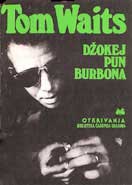
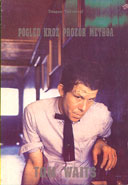
Dragan’s second book came to be in a rather strange
way. Goran Stankovic, editor of the respectable literary
journal Gradina from Nis, Yugoslavia (published since
1900), heard that Todorovic had been working for several
years already on gathering material for a book about Tom
Waits. He called Dragan one day to ask if he would make an
anthology of Waits’ poetry,
translate it into Serbian, and publish as a separate book
with Gradina.
Dragan made a selection and wrote the introductory essay,
titled “The
Times. The Man, The Nightmares.”
Dragan is still
fond of this collection, since it was published in the
same edition with books by John Lennon, Julio Cortazar,
R. W. Fassbinder, Jorge Luis Borges, Susan Sontag, and
Walter Benjamin, among others.
Excerpt from “The Times. The
Man. The Nightmares”:
[...]
Nightmares
Tom Waits’ second album, from 1974, is titled
The Heart of Saturday Night, but all his songs are dossiers
from the same heart. In spite of his living on the sunny
side of American mainland, he is definitely man of the
night; astronomical night, night of character, night of
fate. To call him a chronicler of the nightmarish parts
of the American Dream would be wrong just because his poetic
expression doesn’t belong to the category of chronicle.
The technique Tom Waits uses to produce his poetic visions
is deceptively simple: put together symbols of the American
life, weave through a tragic story, and build fine details
into it all.
Truly, his songs are full of car brands, all
of them glistening with their chrome parts like lights
on a Christmas tree under which only good children will
find presents. The rest will get a bullet or a knife,
the Spanish boot or parole, depending on how fast they
drove through the American night and whom did they hit
when their brakes died. Indeed, on the map of Waits’ verses
there are small towns, back streets, dark corners, dingy
bars. Really, a lengthy list of drinks, pills, drugs and
other wings for fast takeoff and short flight. Definitely,
a decent list of lifers in his songs.
Waits’ poetry, thus, contains American
symbols and tragic fates and a whole range of details,
but it contains much more than these ingredients
for successful elegies. Like no other living author on
the American scene Tom Waits has that rare talent for
creating an amalgam of hope and hopelessness, of doom
and resurrection. Although the characters from his poems/stories
are mostly dead in social sense, the author always leaves
at least a hint where the keys to the exit might lie.
These are not the keys in moralistic sense; they are
not the keys to Atonement and Oblivion, but answers that
the characters themselves would choose, if only they
knew there was something to choose. Romeo, who hides
his wound while he tells his friends how he killed a
cop, sneaks onto the balcony of a cinema, to "die
without a wimper like every hero’s dream ,
just an angel with a bullet and Cagney in the screen".
The Minneapolis hooker, who writes a long, bitter postcard,
hints in the end she would be eligible for parole in
two months.
And
that is, maybe, the most important message that Waits
conveys: no matter how deep the bottom, there is always
some way up – if not to the top, then at
least to some
higher floor.
[...]
|